


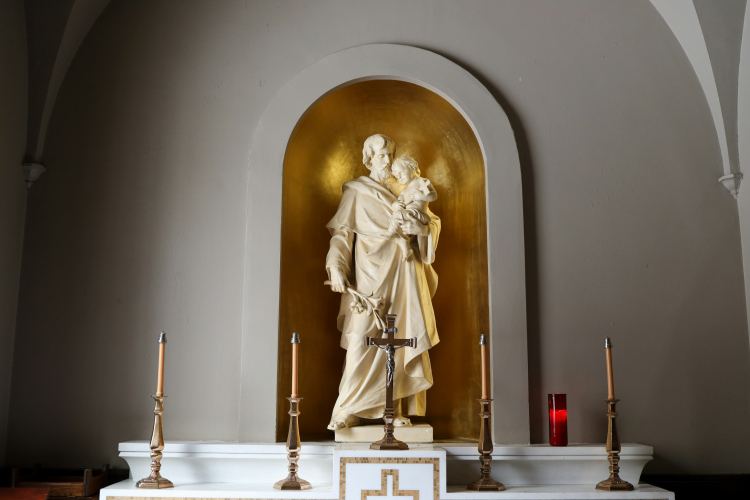
As more Gen Z men explore religion and alternative career paths, while their peers increasingly embrace socialism and communism, the feast of St. Joseph the Worker — May 1st — takes on a new relevance. This convergence of trends presents a timely opportunity for the Church to re-emphasize Joseph, the foster father of Jesus Christ, as a model for young men seeking stability and purpose amid shifting cultural currents.
In an April Gallup survey, 42% of American young men say religion is “very important” — which is not only an increase from 28% in 2022-23, but also outpaces young women. While not quite a revival, at least statistically, prognosticators have noted a percolating phenomenon with Catholicism in particular attracting this demographic.
At the same time, college enrollment among Gen Z has declined. Instead, 60% of young men are more likely to pursue careers in construction, electrical work, and plumbing, with the rise in artificial intelligence, college debt, and job security as driving factors. In response, institutions like the College of St. Joseph the Worker are emerging, combining vocational training with a faith-based lens.
Economic realities are also difficult to ignore. Surveys consistently show Gen Z grappling with debt, underemployment, market instability, and limited housing affordability. Indeed, there is a ‘failure to launch’ problem with plenty unable to afford leaving their parents’ homes. Against this backdrop, favorability of socialism and communism has grown, with 38% of Gen Z expressing favorable views — up from 18% in 2010 among similar age groups.
Together, these trends point to a generation — and particularly young men — at a crossroads, navigating questions of purpose, true masculinity, and economic stability.
In that context, the Church’s designation of May 1 as the feast of St. Joseph the Worker appears especially prescient and timely, and an opportunity to engage a demographic increasingly receptive of religiosity.
St. Joseph’s quiet witness in Scripture speaks volumes. Described as a “just man,” one of the few in Biblical history, Christ’s foster father was pious; humble in trusting God’s will; charitable by welcoming the Virgin Mary into his home; diligent in his carpentry; and action-oriented, protecting and providing for the Virgin Mary and Jesus, even so far as leading the Holy Family’s flight to Egypt to escape authoritarian danger.
For his witness, he has been named patron of the universal Church and recognized as our spiritual father.
Throughout Church history, saints and pontiffs have revered St. Joseph’s silent fortitude, intercession, and work ethic. As St. Josemaría Escrivá once preached:
“Joseph was a strong man, a working man, yet his life was permeated by deep faith. Work was for him not merely the way to earn a living, but a way of serving God and others. In his life we see how ordinary work can become a path to holiness.”
God created work — and, as such, work is inherently good. Man was designed to “till the ground.” As The Catechism of the Catholic Church teaches, “Work honors the Creator’s gifts and the talents received from him,” but it “can also be redemptive.” Even at His ascension, Christ gave a new directive to evangelize, which, in itself, is a holy work.
In short, we are not meant to be idle; nor will we be idle in heaven, but fully united in God’s salvific work.
For men, who are instinctively providers, work is a crucial aspect of one’s identity and responsibility; and likewise, an available avenue for insidious forces to wreak havoc in the human heart, plaguing and bombarding men with doubts, lack of confidence, and even self-worth.
Communism is such a force — because the ideology’s bedrock removes God from the sphere, thus reducing work to mere materialism. The Church has repeatedly rejected the ideology. Within the century since Karl Marx and Friedrich Engels published The Communist Manifesto (1848), the Church released several encyclicals denouncing its atheistic and totalitarian roots, even so far as labeling it a “satanic scourge.” As clearly emphasized in Divini Redemptoris (1937), “[Communism] subverts the social order, because it means the destruction of its foundations; because it ignores the true origin and purpose of the State; because it denies the rights, dignity and liberty of human personality.”
That is why the Vatican, in 1955, instituted the feast day of St. Joseph the Worker: to specifically counteract communistic endeavors which aimed to not only distort man’s relationship with work, but to usurp the secular holiday, May Day, and re-designate it as “Communist Worker’s Day.”
When announcing the new feast day, Pope Pius XII offered St. Joseph as a prime model — the “humble craftsman of Nazareth” — who “embod[ied] before God and the Holy Church the dignity of the manual laborer” and a “provident guardian” of families, as opposed to communism’s vision for workers.
That witness remains relevant today; and the Church, once again, should prioritze the importance and wisdom of St. Joseph the Worker. As Knights of Columbus Supreme Knight Patrick Kelly wrote in a recent column, Christ’s foster father is a “model of authentic masculinity: humble, obedient, courageous.”
Men need models. And as Archbishop Fulton Sheen once observed, we imitate what we love.
In an era marked by uncertainty and materialism in the cultural and economic landscape, yet renewed spiritual interest among young men, St. Joseph’s steadiness is the answer, and imperative to imitate. In his quiet witness, and even financial poverty, Christ’s foster father faithfully oriented his heart not to comfort and recognition, but heaven, even if he knew not the path ahead.
True purpose and happiness cannot fill the infinite chasms of the human heart — only God’s love and mercy can. St. Joseph recognized this truth. In the end, he lived a holy life, died a holy death, and — after the Virgin Mary — has been deemed the greatest saint to ever live.
On this feast day, men — go to St. Joseph. He will not let you down, but raise your heart toward Him in whom we find rest and fulfillment.
St. Joseph the Worker, pray for us!
Read Full Article »